

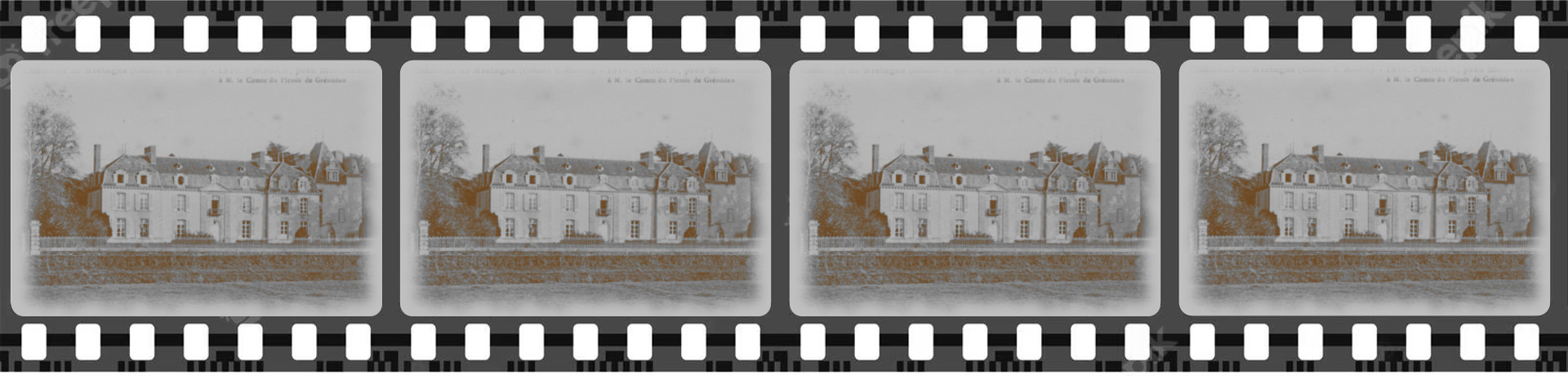
History
Bogard’s story begins in 1274…
Mentioned in a charter of 1274, Bogard (or Bogar) takes its name from “bogue” (chestnut) and “ardere” (to burn). Bogard is a juveignerie of the barony of Yffiniac, i.e. a fief created for a cadet whose descendants bear the name.
The de Bogard family produced a number of officers, lawyers and ecclesiastics. Jean de Bogar was one of 60 Bretons who paid tribute to Louis XI. The last, Jean, was seneschal of Moncontour. His grandfather built the south pavilion in the early 16th century. He bequeathed the estate to his niece, wife of Mathurin Le Metayer, Seigneur de La Rivière (from whom General La Fayette’s mother descended as a collateral branch).
Anne Le Metayer married Henri de Le Noüe, grand-nephew of the famous “La Noüe – Bras de Fer”, also known as the Bayard Huguenot, companion-in-arms of Henri IV, who died in a battle between Protestants and Catholics at Moncontour in 1591.
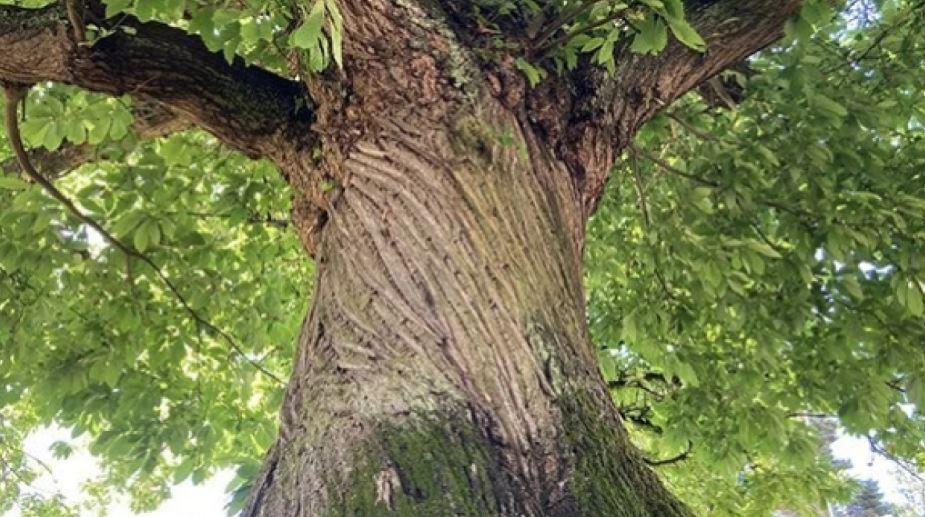
Bogard’s story begins in 1274…
Mentioned in a charter of 1274, Bogard (or Bogar) takes its name from “bogue” (chestnut) and “ardere” (to burn). Bogard is a juveignerie of the barony of Yffiniac, i.e. a fief created for a cadet whose descendants bear the name.
The de Bogard family produced a number of officers, lawyers and ecclesiastics. Jean de Bogar was one of 60 Bretons who paid tribute to Louis XI. The last, Jean, was seneschal of Moncontour. His grandfather built the south pavilion in the early 16th century. He bequeathed the estate to his niece, wife of Mathurin Le Metayer, Seigneur de La Rivière (from whom General La Fayette’s mother descended as a collateral branch).
Anne Le Metayer married Henri de Le Noüe, grand-nephew of the famous “La Noüe – Bras de Fer”, also known as the Bayard Huguenot, companion-in-arms of Henri IV, who died in a battle between Protestants and Catholics at Moncontour in 1591.
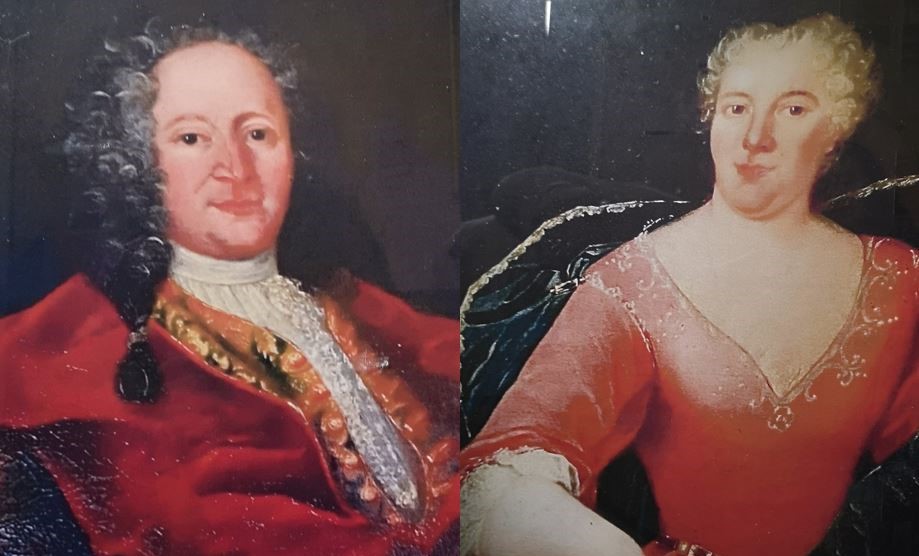
The Château was built in the 18th century…
A couple both traditional and modern, Guillaume-François de La Noue, Councillor at the Parliament of Brittany and Master Freemason, and Félicité Meslé de Grandclos, daughter of a wealthy Saint-Malo shipowner, sealed the union of nobility and financial fortune.
Guillaume-François de La Noüe was a page to Louis XV at Versailles, then a Cavalry Officer, Lieutenant of the Marshals of France and Knight of the Holy Sepulchre. In 1776, he married Felicité Meslé de Grandclos. Together, they designed and built the Château de Bogard as you see it today. To do so, they modified the structure of the former manor house (of which the 16th-century tower remains a witness) and destroyed its buttresses. They then went on to build the current château, inspired by the ideas of the Age of Enlightenment and Freemasonry.
The site you are visiting has not been modified since…
Evidence of Freemasonry in the 18th century…
Guillaume-François de La Noüe was a Master Freemason. We assume that his wife was also a Freemason, at least in spirit, as lodges were originally for men, for agreeing to finance such a life project! The entire architecture of Château de Bogard and the surrounding gardens are organized and built according to Masonic symbolism. Numerous interior elements also reveal this membership.
Masonic symbolism thus permeates the premises, invisibly to the uninitiated but discreetly obvious to the initiated…
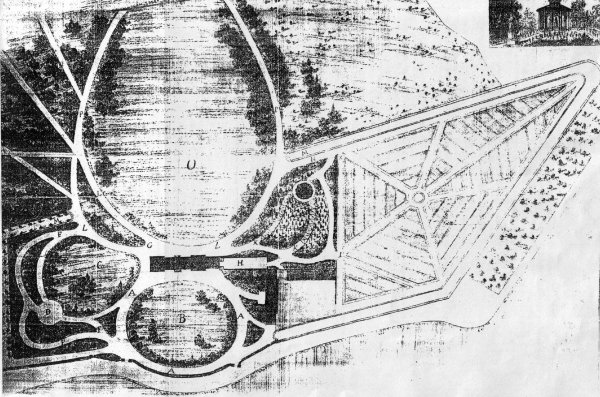
Evidence of Freemasonry in the 18th century…
Guillaume-François de La Noüe was a Master Freemason. We assume that his wife was also a Freemason, at least in spirit, as lodges were originally for men, for agreeing to finance such a life project! The entire architecture of Château de Bogard and the surrounding gardens are organized and built according to Masonic symbolism. Numerous interior elements also reveal this membership.
Masonic symbolism thus permeates the premises, invisibly to the uninitiated but discreetly obvious to the initiated…
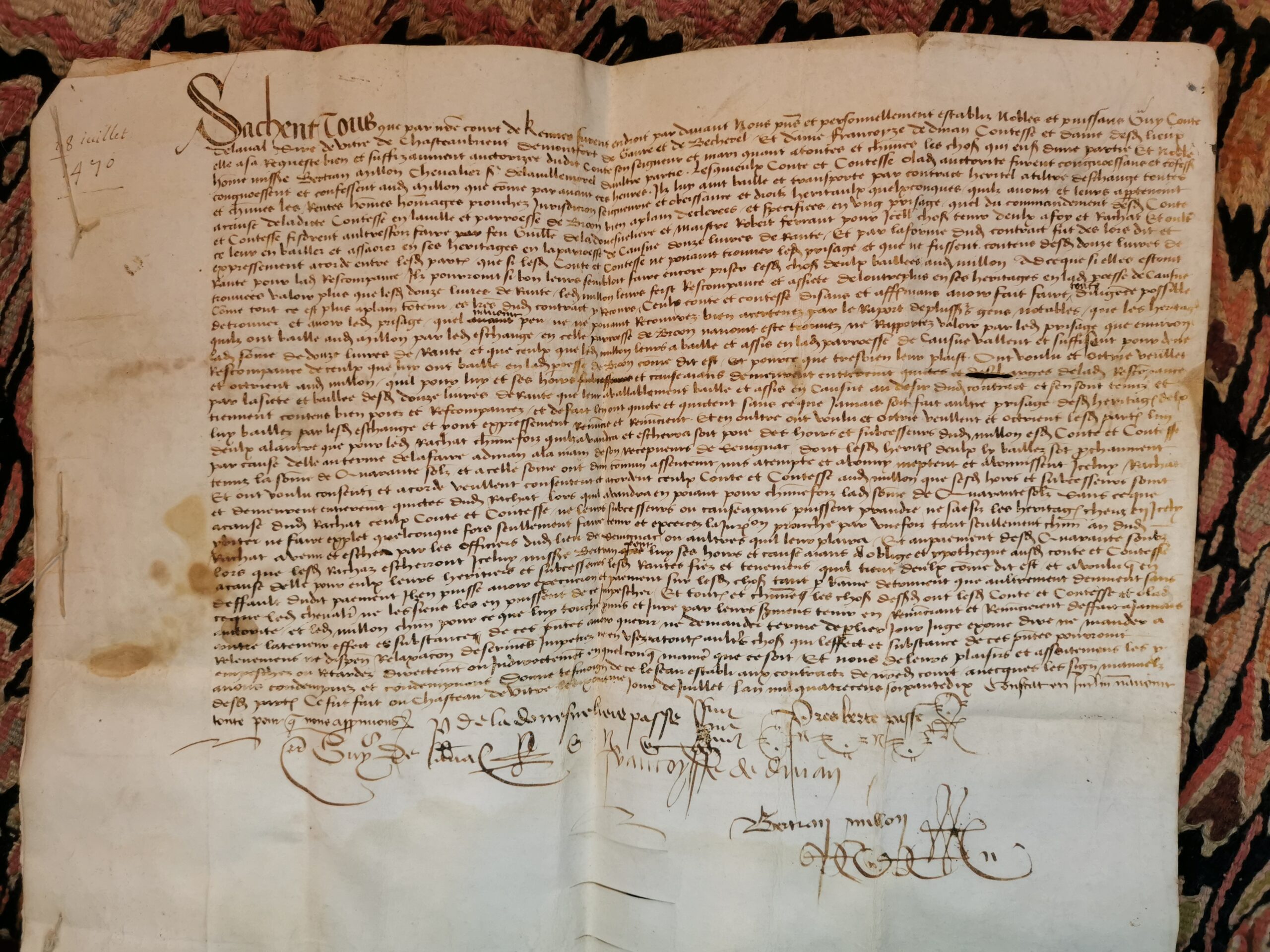
A forgotten story rediscovered by chance in the 20th century…
Bogard was inherited from generation to generation within the Bogard family and its successive alliances. In 1960, for the first time in its history, the château was sold as a working farm and purchased by the Capelle family.
The La Noüe couple, who designed and commissioned the château as it stands today, and the hidden meaning of its architecture, had been lost to history. It was by chance that the Capelle family discovered archives hidden in the attic, revealing a Breton history that had been forgotten for almost 200 years…
Since then, the Capelle family has worked hard to make this story known, and to restore the Château de Bogard to the splendor it enjoyed in the 18th century.
The Capelle family will receive an honorary diploma and the IESA (Institut des Etudes Supérieures des Arts) prize for their work in restoring historical heritage. Mr. Baudoin Capelle, current co-owner of Château de Bogard, was awarded the Ordre des Arts et des Lettres. He has also been elected Regional Delegate of the VMF association for Brittany. Mr. Harald Capelle, also co-owner of the château and a tireless contributor to its restoration, is a member of the Saint-Brieuc Lions Club.



Château de Bogard is a member of the following associations: Demeure Historique (DH), Vieilles Maisons Françaises (VMF), Association des Parcs et Jardins de Bretagne (APJB). The property is also part of the Circuit des demeures de parlementaires bretons de l’Ancien Régime.
Château de Bogard is a member of the following associations: Demeure Historique (DH), Vieilles Maisons Françaises (VMF), Association des Parcs et Jardins de Bretagne (APJB). The property is also part of the Circuit des demeures de parlementaires bretons de l’Ancien Régime.
Discover the entire history of the site, from the Middle Ages to the present day, by reading the book we published in 2025 to mark the site’s 750th anniversary.
84 pages telling the story of the place from the Middle Ages to the present day, with family anecdotes and lots of color photos. Click on the image to see the first pages…
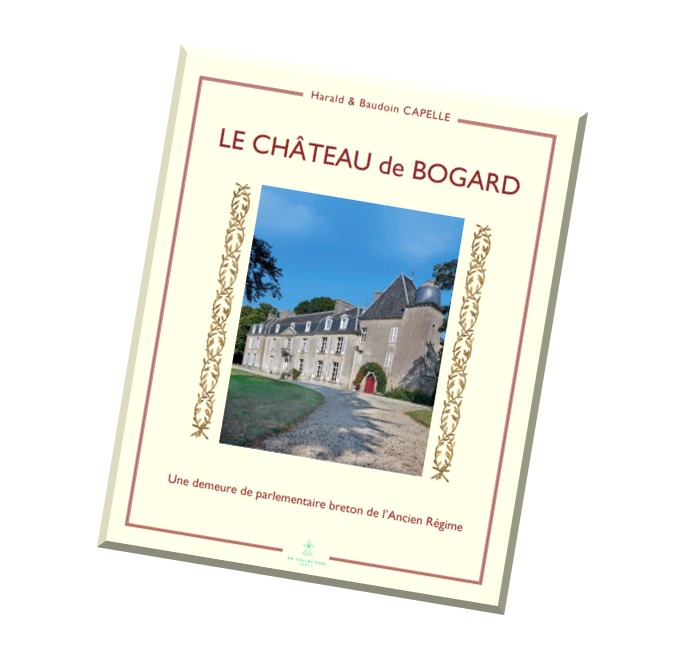
Discover the entire history of the site, from the Middle Ages to the present day, by reading the book we published in 2025 to mark the site’s 750th anniversary.