

History Tour – Step 7
Listen to the recording :
Click on the image to make it bigger :
Text of the recording below :
Let us pause for a few moments in the shade of the hornbeams around us and take a little detour into history. Bogard is a placename on which several manor houses were successively built. The oldest historical trace found mentioning a manor at Bogard dates back to 1274, 750 years ago.
The owner at the time was a knight named Alain Le Noir. We know this thanks to a “charter,” an official document indicating that this knight owned a manor at “Bogard” and undertook to pay a number of tithes to the Abbey of Saint-Mélaine in Rennes. In the Middle Ages, tithes were a tax calculated on harvests and owed to the Church. This legal document is the oldest historical trace attesting to the existence of a dwelling on this site.
At the time, the fief of Bogard was attached to the town of Moncontour, an important medieval town under the authority of the Duke of Penthièvre, himself a vassal of the Duke of Brittany.
The name Bogard is thought to derive from the combination of the words “bogue,” of Gaulish origin, meaning the husk of a chestnut, and “ardere,” a Latin verb meaning “to burn.” There must originally have been a chestnut wood that was cleared and burned to create the first dwelling on this site.
It is interesting to note that in the Middle Ages, the names given to properties were compound words, one part designating a particular feature of the estate and the other the method of cultivation. This is why so many places are called “les essarts,” derived from the Latin verb “essarter,” meaning “to clear land.” Other places have names ending in “igny,” because “ignis” in Latin means fire. All these names recall the medieval period, when land was cleared and burned in order to farm and enrich the soil.
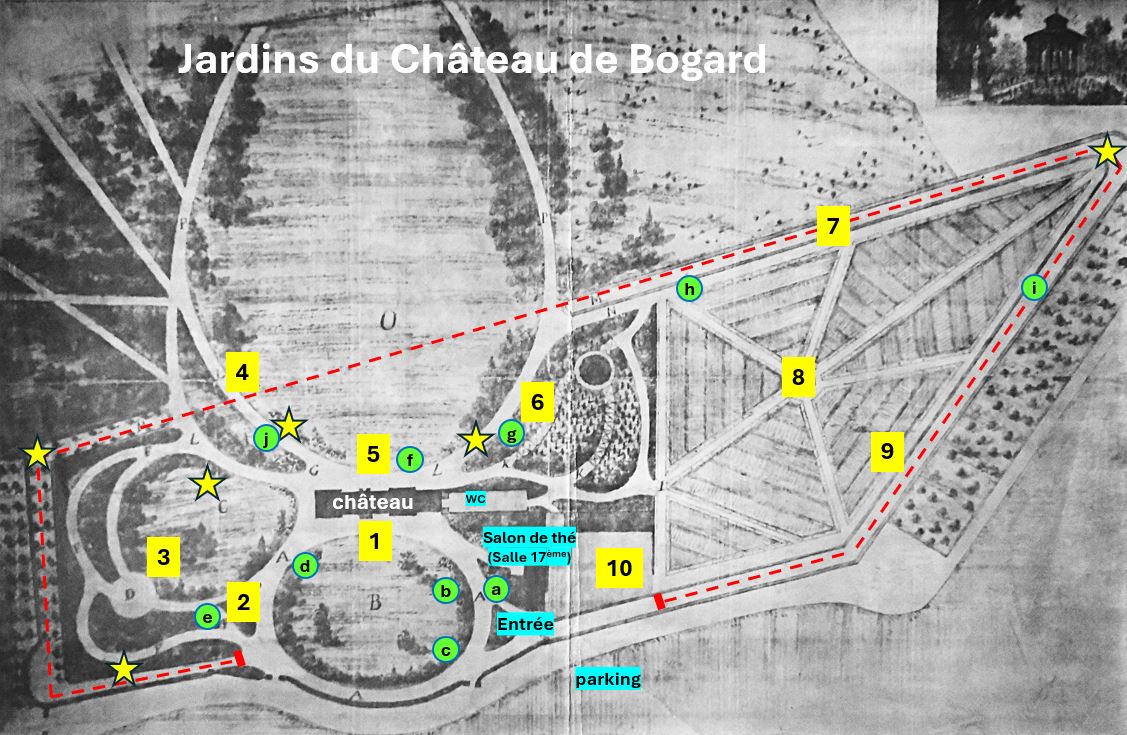
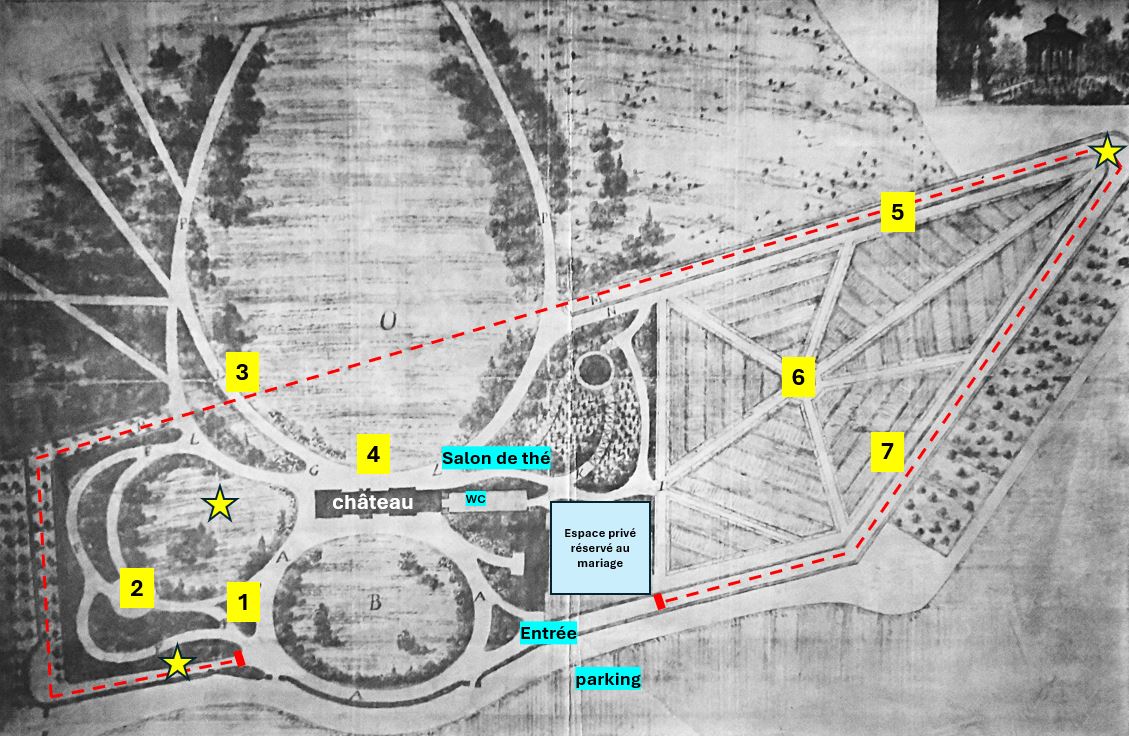
To protect the various manor houses built on the land of Bogard, terraces were erected around the estate in the Middle Ages, to mark its boundaries and to guard against unwanted intruders. Traces of the medieval terraces still exist today. They are now bordered by hornbeams, which allow, as you are doing today, a pleasant, shaded walk all around the gardens of Château de Bogard, following the route marked with a red dotted line on the map of the Gardens.
Bogard is, moreover, a place whose small, local, family history repeatedly crosses paths with the larger history of Brittany and France, from the Middle Ages to the present day, including the French Revolution. It is also worth knowing that the various manor houses built at Bogard, and later the château built in the 18th century, were passed down for 750 years exclusively by inheritance or marriage. The only time in its entire history that the property was sold was in 1962, when Mr. and Mrs. CAPELLE, parents of the current owners, became owners of the château. Apart from this single sale, the estate was passed down for seven centuries exclusively by inheritance or marriage within four great Breton families: the de Bogar family, the Le Métayer family, the de La Noüe family, and the du Plessis de Grenédan family.
Let us continue our visit to the next stage. We invite you to take the full loop around the medieval terraces to discover a lovely viewpoint at the end of the path, as well as the hornbeam bowers marked with the letter “i” on the map. If you prefer a shorter route, you can go directly to the next stage by cutting across one of the garden paths before you…