

History Tour – Step 4
Listen to the recording :
Click on the image to make it bigger :
Text of the recording below :
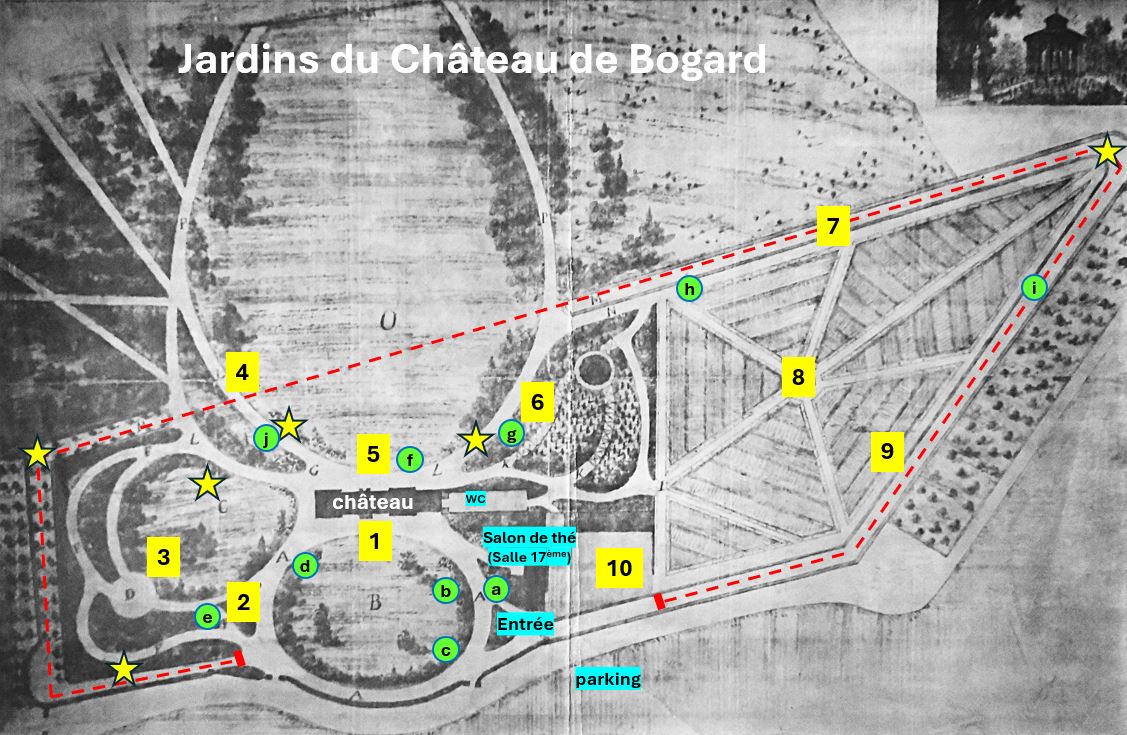
Several sculptures are dotted throughout the Gardens of Bogard. Here you will find a reproduction of the Bather by Falconet, an 18th-century sculptor, one of the favorites of Madame de Pompadour, patron of the arts under Louis XV.
The sculpture depicts a young woman seated on a rock, half naked, holding a cloth that partially covers her body. Her head is slightly tilted; her expression is gentle, dreamy. The sculpture expresses the 18th-century ideal of feminine beauty: elegance, grace, modesty mixed with sensuality. The body is soft and supple, without tension. Nudity is restrained, not provocative, delicately suggestive, evoking a nature that is both innocent and sensual. The scene is neither mythological nor religious: it captures an intimate, domestic, almost private moment. It is a humanized vision of women, far from the idealized goddesses of antiquity, with a poetic quality close to the world of gallantry. Falconet also plays with textures: smooth skin, soft cloth, rough stone. The Bather’s pose is natural and fluid, which was innovative at the time, in contrast to the classical rigidity of the previous century’s art.
Falconet’s Bather can be seen as a celebration of natural feminine beauty, a metaphor for purification and a return to nature, and a reflection of 18th-century aristocratic values: art for pleasure’s sake, unveiled sensuality, an escape from moral and political heaviness.
A little further on, hidden beneath the foliage of the trees, you will discover another statue of a Bather, this time by Rodin. Rodin was a 19th-century sculptor. His sculpture does not seek to depict the Bather as an object of gallant contemplation in the manner of Falconet, but as a being in inner motion. The posture is compact, drawn in, folded upon itself, symbolizing meditation, modesty, a withdrawal from the world, vulnerability, even intimate suffering. We have moved from the natural lightness of the 18th century to the romantic torments of the late 19th century.
Another secret of the place: in the 18th century, the gardens were planted with acacias, a tree highly symbolic for Freemasons. Acacia, being rot-resistant, is a symbol of eternity. It is also the recognition sign of Master Masons, as it represents the victory of spirit over matter, the immortality of the soul that lives within us.
Let us continue our visit to the next stage toward the pergola and the globe…