


History Tour – Step 6
Listen to the recording :
Click on the image to make it bigger :
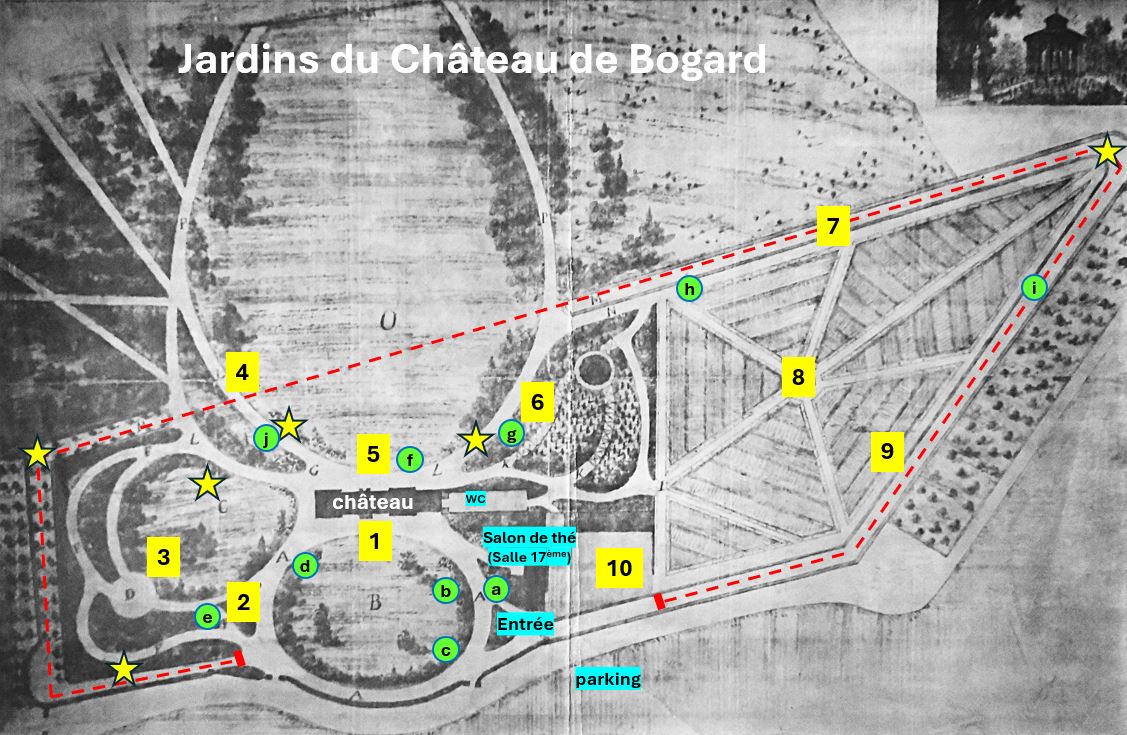
List of the trees and the plants :
a) gunnera
b) copper beeches
c) pink-flowering horse chestnut
d) holy oak
e) ginkgo biloba
f) peonies
g) tulip trees from Virginia
h) a hornbeam pruned into a “goblet” shape
i) hornbeams alley
j) two loving oaks
Text of the recording below :
During your walk, you have encountered, or will encounter, various trees and plants. It is time to give you some explanations.
Let us begin with the “gunnera,” marked on the map with the letter “a” near the entrance. This is quite an impressive plant, originally from India, which generally grows in wet, marshy regions. Its leaves are cut back in autumn and used to cover the base of the plant to protect it from frost in winter. Each spring, the plant grows back, so the leaves you see are this year’s growth. They are very large and can measure more than 1.5 meters across.
Let us continue with the “copper beeches,” also near the entrance, marked with the letter “b” on the map. These are two large ornamental trees in front of the château. They are accompanied by a “pink-flowering horse chestnut,” marked with the letter “c.” On the other side of the lawn facing the château, you will find a “holy oak,” marked with the letter “d.”
Near the Rough Stone, you passed a “ginkgo biloba,” marked with the letter “e” on the map. This is a very ancient tree, famous in particular for being among the first to grow back after the bombing of Hiroshima, Japan, that ended the Second World War, demonstrating its resilience against the harmful effects of nuclear radiation.
Earlier you passed a collection of pink “peonies,” marked with the letter “f” on the map. These peonies came from Normandy in the mid-20th century, from a previous property, so they are very old. You should know that in the Le Mans region, at the Château de Sourches, in the deep, dry moat of the property, there is a planting of several thousand peony plants that can be visited in spring — quite a unique sight in France, which we recommend you visit.
In the curved path where you now stand, “tulip trees” have been planted, marked with the letter “g” on the map. Tulip trees were brought over from America. They take a very long time to establish themselves and do not flower until about ten years after adapting. Their flowering is quite pretty, in subtle shades of yellow and orange, and appears in spring, in June.
A little further along the route, you will walk along the line of the medieval terraces, now bordered by “hornbeams.” Some of these hornbeams are very old and were trained back in the 18th century. You will be able to recognize one of them, marked with the letter “h,” which is quite unusual as it has been trained into a “goblet” shape, that is with branches at mid-height forming a rectangular structure. The tree has widened over time but has kept the original shape the gardener of the time wished to give it.
As a fun fact: do you know how to tell a hornbeam from a copper beech? Their leaves really do look alike. Can’t guess? In French there is a mnemonic phrase for it : “being naked, charming Adam”, which plays on the fact that beech leaves have small hairs, while hornbeam leaves do not.
Speaking of hornbeams, have you spotted the two “loving oaks,” tenderly intertwined? They are marked with the letter “j” on the map.
You will find the full list of all these trees and plants on the page you have just scanned.
Let us continue our visit to the next stage. To help you find your way, continue along the curved path, and in a few meters you will reach the start of the medieval terraces that run along the boundary wall.