
History Tour – Step 5
Listen to the recording :
Click on the image to make it bigger :
Text of the recording below :
In Freemasonry, the chequerboard and the astrolabe are two very important symbols.
The chequerboard, also known as the mosaic pavement, is found at the centre of Masonic lodges. It alternates black and white squares, symbolizing first of all the inherent duality of the human condition, caught as we are between Good and Evil, Life and Death, Light and Darkness, Joy and Suffering, Spirit and Matter.
But this binary opposition is only apparent, for the chequerboard also symbolizes the possible harmony of opposites, the need for balance and discernment in a spiritual and moral quest. This alternation reminds us that human beings evolve in a world where opposites do not cancel each other out but complement one another. Though made of opposition, the chequerboard is an invitation to tolerance and to the understanding of differences in the search for a higher unity.
Lastly, the chequerboard symbolizes the journey of life, made up of trials and doubts, but also of light and revelations. It symbolizes the game of life, the chessboard on which we all play. It invites everyone to become aware of their own areas of shadow and light in order to progress morally. It embodies the idea that the right path consists in seeking balance, in recognizing and integrating contradictions of existence, like a tightrope walker on the fragile thread of life.
Let us now talk about the astrolabe. To understand this symbol, we must remember that Freemasonry is a philosophical movement born at the end of the 17th century in Scotland, which developed throughout Europe and America over the course of the 18th century, otherwise known as the Age of Enlightenment. We are at a crucial period in history. Power still lies mostly in the hands of absolute monarchies. The Church reigns supreme over souls. Freedom of conscience is almost non-existent and severely punished. And yet, for more than two centuries, since the Renaissance and the Age of Discovery, the West has continued to uncover new knowledge and new territories, with the exploration of Latin America and circumnavigations of the globe and has continued to rediscover the ancient texts of Greek and Roman philosophers, spread thanks to the invention of the printing press in the 15th century.
The earth is no longer at the centre of the universe, as was believed in the Middle Ages. It is round and finite. It is at once infinitely large on our human scale and infinitely small on the scale of the universe. And as Copernicus asserted, at the risk of his life, in the 16th century: it is not the sun that revolves around the Earth, but the Earth that revolves around the sun, revolutionizing cosmological and religious thought. A great many scientific discoveries thus transformed the understanding of the world, transformed the understanding of the human being and our place in the universe, transformed the way of conceiving life and our relationship to ourselves and to God, and transformed our social bonds, our relationship to religion and to political power.
The astrolabe symbolizes this new knowledge of the world, giving rise to new philosophical and political perspectives. The instrument also symbolizes the ceaseless quest for scientific knowledge, to better understand, day by day, the laws of the universe, and to better know oneself.
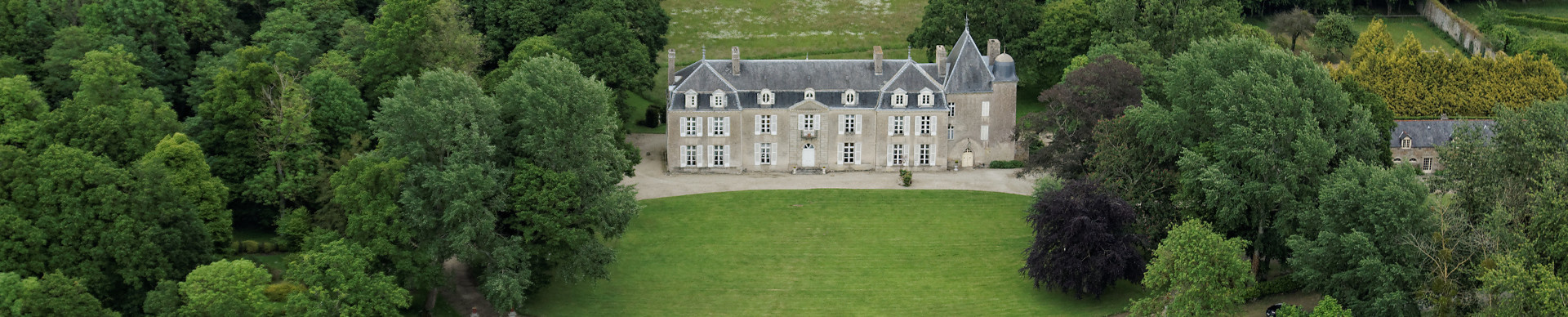
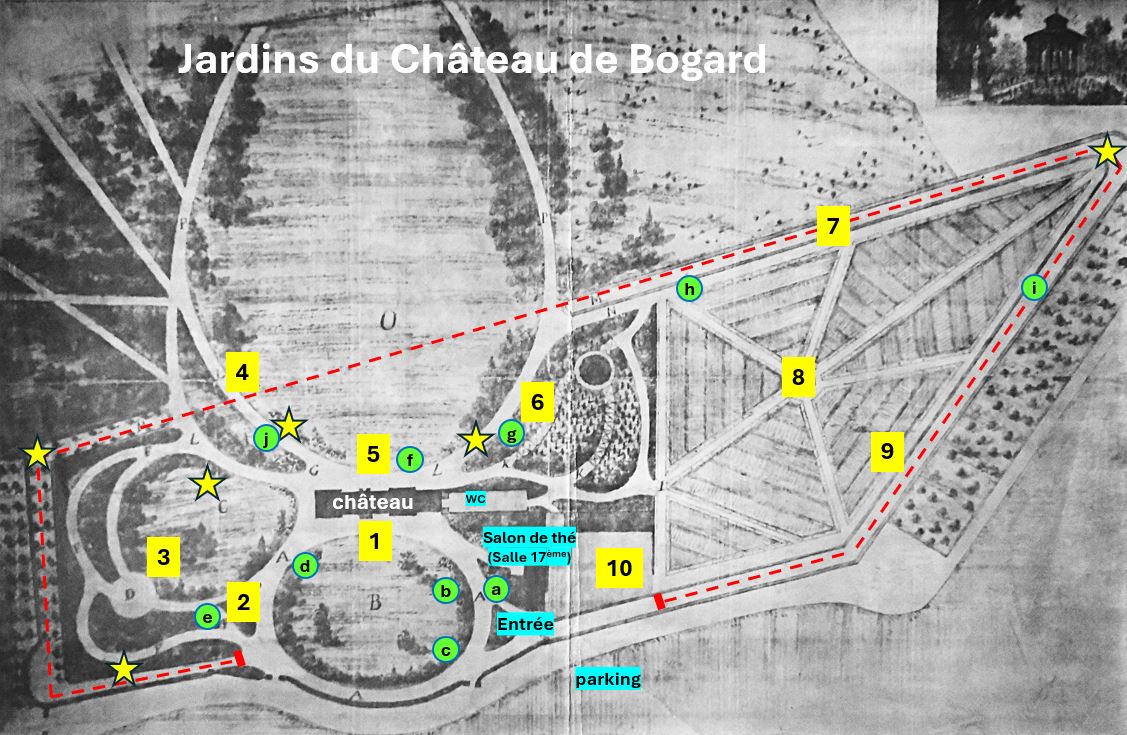
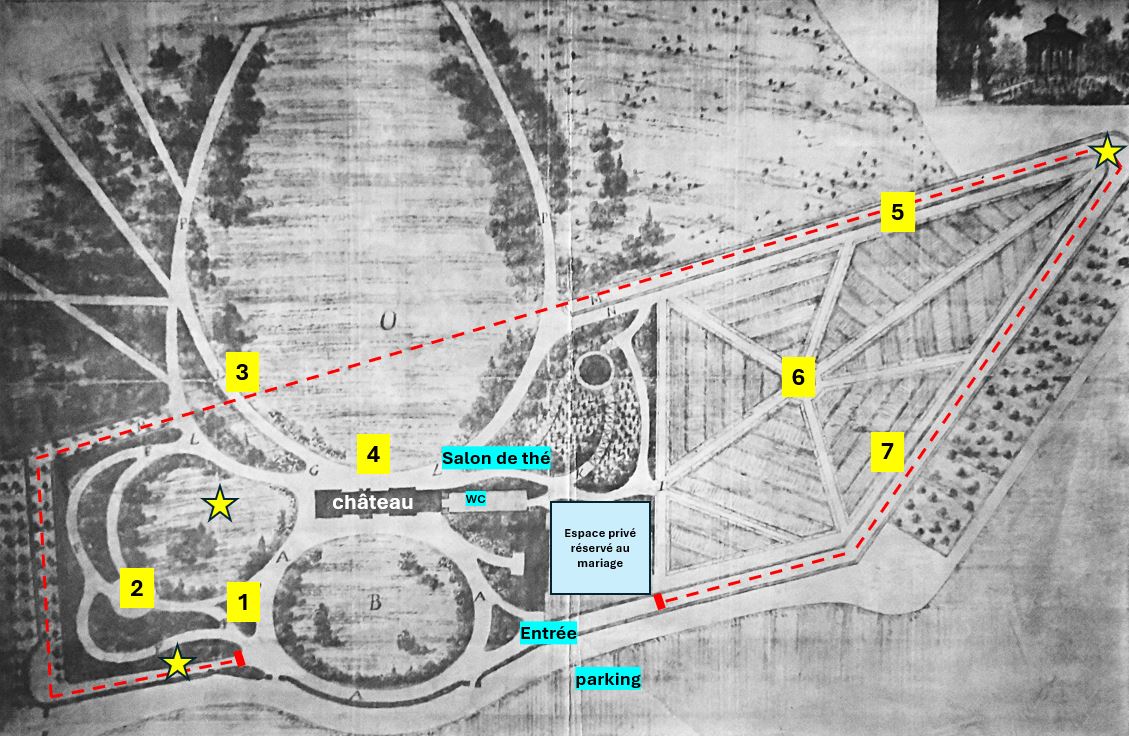
You should also know that the North-South and East-West axes of the gardens cross at the site of the château, which was itself a place where Masonic meetings were held in the 18th century. A library on the first floor, at the crossing of the axes, served as the Lodge, and the reception rooms on the garden level served as a space to gather for a shared meal, otherwise known as “agapes.” The château is thus the link between all these symbols, their nerve centre.
Let us continue our visit to the next stage …